Brine and the Bottom Line: How Small Farms Are Turning Surplus into Ferments
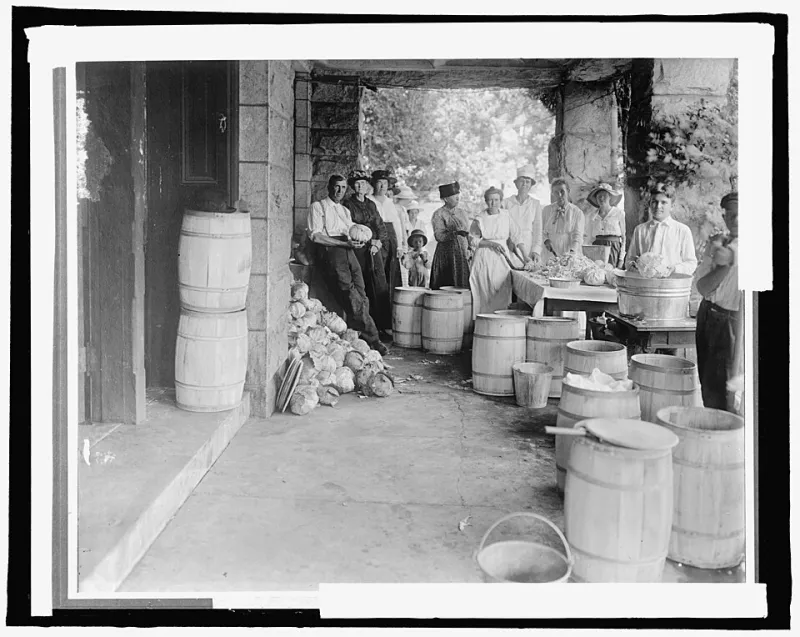
Photo: National Photo Company Collection, Public domain, via Wikimedia Commons
At a farmers market in late October, the prettiest cabbages go first. The split heads, the loose leaves, and the ones that are a little too small for a restaurant order tend to sit. That used to be a quiet loss for small growers. In 2026, it is increasingly the raw material for a second business.
Across the country, farms and small food makers are turning surplus and seconds into fermented vegetables: sauerkraut, kimchi, curtido, giardiniera, and the kind of bright, crunchy pickles that show up in local grocery coolers with handwritten labels. The products are shelf-stable, distinctive, and tied to a place in a way that a commodity jar of kraut is not.
Why Fermentation Fits the Farm
Fermentation solves several farm problems at once. It extends shelf life without a freezer. It turns a low-value, highly perishable crop into a high-value pantry item. It gives CSA members something new in the box and gives market shoppers a reason to come back in winter. And it lets a grower use up vegetables that are perfectly good but not photogenic.
The business case is not magic, but it is real. A pound of cabbage might sell wholesale for a dollar or two. That same pound, salted and fermented, can fill roughly one and a half to two 16-ounce jars. At a farmers market price of eight to ten dollars a jar, the value-added product captures far more of the retail dollar. The catch is that the grower also takes on labor, licensing, testing, jars, labels, and liability.
That is why the successful operations tend to be deliberate. Some farms build a licensed processing kitchen on site. Others rent time in a commercial kitchen or work with a co-packer. Some start with a single product and a small batch, then add another only when the first one sells through consistently.
Food Safety Is Not Optional
Fermentation is an old technique, but it is not a casual one. Low-acid vegetables — cabbage, carrots, cucumbers, peppers — need an acidic environment to be safe. The good bacteria produce lactic acid, but only if the conditions are right.
For fermented vegetables, the key controls are salt concentration, temperature, and an anaerobic environment. Salt should be weighed, not guessed. A common starting point for sauerkraut is about 2 percent salt by weight of the cabbage. The vegetables need to stay submerged under the brine, with a weight or a bag to keep them down. Fermentation should happen in a clean container at roughly 65 to 72 degrees Fahrenheit, out of direct sunlight. The pH should drop below 4.6, which is the line that separates a safe acidified food from a low-acid food that needs a different process.
Kahm yeast — a flat, white, slightly wrinkled film — is usually harmless but can affect flavor. Fuzzy mold in colors like green, black, or pink is not harmless. When in doubt, throw it out. For commercial producers, the rules are stricter: state cottage food laws vary widely, and many states do not allow low-acid fermented foods under cottage food exemptions. Acidified foods such as quick pickles have their own requirements. A food-safety plan, pH testing, and a conversation with your state agriculture department are not red tape; they are the price of staying in business.
A Small-Farm Model That Works
One Pennsylvania vegetable grower started fermenting cabbage three years ago after a wet fall left him with a field of split heads. He sold the first batch at the farmers market as a test. It sold out in two hours. The next year, he planted an extra half-acre of cabbage specifically for kraut and added a licensed kitchen in a converted shed. Now the kraut is a winter CSA add-on and a year-round anchor at two local co-ops.
Not every farm needs to build a kitchen. Some makers buy surplus from neighboring farms and focus entirely on fermentation. That model spreads the risk and keeps more local vegetables in the food system. Either way, the product has to taste good and be consistent. Fermentation is forgiving, but customers are not.
How Home Cooks Can Start Small
You do not need a commercial kitchen to get a feel for the process. Start with a small batch of sauerkraut. Shred two pounds of cabbage, weigh it, and add 2 percent of that weight in fine sea salt. Massage the salt into the cabbage until it releases water, pack it tightly into a clean jar, and keep the cabbage submerged under the brine with a small weight or a folded cabbage leaf. Cover loosely and let it sit at room temperature for one to four weeks, tasting every few days. Refrigerate when it tastes right.
For a quick pickle, skip fermentation and use heat and acid. Bring one cup of vinegar, one cup of water, one tablespoon of salt, and one tablespoon of sugar to a simmer. Pour it over sliced cucumbers, carrots, or peppers in a clean jar, let it cool, and refrigerate. It will be ready in a day and will keep for weeks.
The boom in small-batch ferments is not just a trend in a jar. It is a way for farms to keep more of what they grow, for shoppers to taste a place in a pickle, and for home cooks to turn a surplus of vegetables into something that lasts. Start with one jar. See what happens.