Grown Indoors, Year-Round: Inside America's Controlled-Farm Revolution
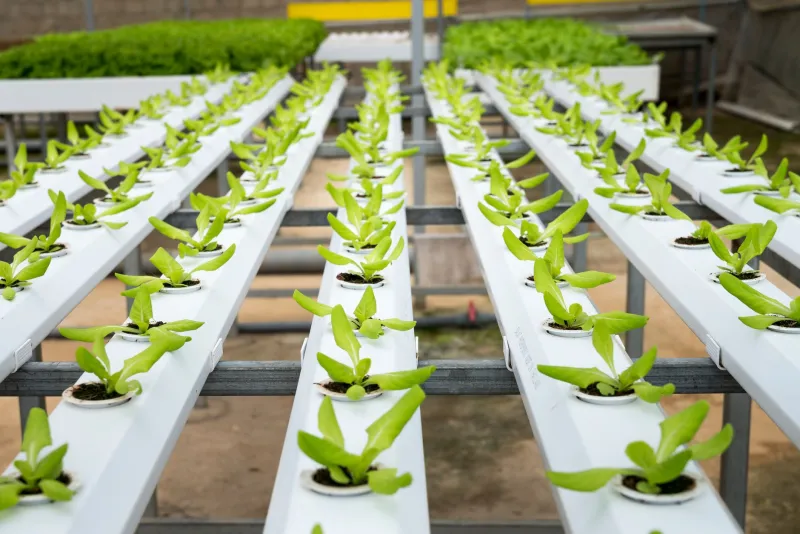
Walk into a vertical farm operation and the first thing you notice is the light. Rows of leafy greens glow under pink and purple LED arrays in what looks less like a farm and more like a science fiction film set. There's no soil — plants grow in nutrient solution or substrate, their roots suspended in carefully controlled conditions. The temperature doesn't fluctuate. There are no pests, no weather events, no seasonal shutdowns.
This is controlled-environment agriculture, or CEA, and it's one of the fastest-growing segments of American food production. From repurposed warehouses in Newark, New Jersey, to purpose-built greenhouse complexes outside Denver, these operations are producing lettuce, herbs, tomatoes, cucumbers, and leafy greens every single day of the year — and marketing them directly to consumers as the local, fresh alternative to imported produce.
But is that claim fully accurate? And what does the rise of indoor farming actually mean for consumers trying to eat well, eat locally, and manage their grocery budgets through the off-season? The answer, like most things in food systems, is nuanced.
How CEA Actually Works
Controlled-environment agriculture is an umbrella term that covers a spectrum of operations. On one end are traditional greenhouses — glass or poly-tunnel structures that use sunlight supplemented by artificial lighting, with soil or soilless growing systems. These have been part of American agriculture for generations; think of the tomato greenhouses that have operated in states like Ohio and Michigan for decades.
On the other end are fully indoor vertical farms — multi-story facilities with no natural light, running entirely on LEDs, with plants stacked in horizontal layers to maximize production per square foot. Companies like AeroFarms (New Jersey), Plenty (California), and AppHarvest (Kentucky, before its 2023 bankruptcy restructuring) have built or planned massive facilities in this category, attracting hundreds of millions in venture capital over the past decade.
In between sits a range of hybrid operations: greenhouse facilities with supplemental lighting, rooftop farms, hydroponic warehouses with partial natural light. Each model has different economics, different energy profiles, and different claims on the word "sustainable."
The Case For Indoor Farming
The genuine advantages of CEA are real and worth taking seriously.
Year-round production reduces import dependency. During winter months, a significant portion of US fresh produce — particularly leafy greens and tomatoes — comes from Mexico, California, and Florida. That produce travels hundreds to thousands of miles, spending days in refrigerated transit. A greenhouse or vertical farm in the Midwest or Northeast producing the same crops locally eliminates that shipping footprint entirely.
Water efficiency is genuinely impressive. Hydroponic and aeroponic systems typically use 70-95% less water than field agriculture for equivalent yields. In a country where agricultural water use is an increasingly serious issue, that's not a minor point.
No pesticides in most operations. The controlled environment essentially eliminates the pest pressure that drives conventional pesticide use. Most CEA operations grow without any synthetic pesticides, which matters both for environmental reasons and for consumer preferences.
Consistency and food safety. Indoor farms can maintain extremely consistent quality and are easier to monitor for food safety contamination — a significant advantage in an era of recurring leafy greens recalls linked to field agriculture.
The Honest Accounting on Energy
Here's where the picture gets more complicated. Fully indoor vertical farms are energy-intensive operations. Running LED lighting 18-20 hours a day, maintaining precise climate control, and powering nutrient delivery systems adds up. Studies examining the carbon footprint of indoor vertical farms have found that, depending on the local electricity grid, the energy cost of producing a head of lettuce indoors can actually exceed the carbon cost of shipping that same lettuce from California.
A 2021 analysis published in Nature Food found that vertical farm lettuce produced in regions powered by coal-heavy electricity grids had a carbon footprint up to six times higher than field-grown lettuce. In regions with cleaner energy — the Pacific Northwest, parts of New England — the math improves significantly.
This is why the sustainability claims of indoor farming are highly location-dependent. A vertical farm powered by renewable energy in a region with a dirty grid and a long shipping distance from field agriculture can be a genuine environmental win. The same farm in a region with abundant winter sunlight and easy access to domestic field production may not pencil out as clearly.
Greenhouse operations — which use natural light as their primary energy source — generally have a more favorable energy profile than fully indoor vertical farms, and many industry observers see large-scale greenhouse production as the more immediately scalable model.
What Operators Are Actually Saying
We spoke with operators across a range of CEA models to get a ground-level view.
"We're not trying to replace field farming," says one Midwest greenhouse tomato grower who supplies regional grocery chains through the winter months. "We're filling a gap. When local field tomatoes are done in October, our customers have a choice between our product grown 30 miles away or something that's been on a truck for a week from Mexico. We think that's a meaningful difference."
That framing — CEA as a complement to field agriculture rather than a replacement — seems to be where the most credible operators have landed. The vision of vertical farms feeding entire cities through year-round production of staple crops has run into the hard economics of energy costs and capital requirements. Several high-profile vertical farm companies have scaled back or restructured in recent years.
What's proving more durable is the greenhouse model, particularly for crops like tomatoes, peppers, cucumbers, and herbs where year-round consumer demand is high and the economics of local production can compete with long-distance shipping.
Making Smart Choices as a Shopper
For consumers trying to navigate this during the off-season, here's a practical framework:
Greenhouse-grown beats long-haul shipped, generally. If you're choosing between a greenhouse tomato grown in your state and one shipped from 2,000 miles away in January, the greenhouse option is almost certainly fresher, likely more nutritious, and probably has a smaller carbon footprint.
Ask about energy sourcing. Some indoor farm brands are transparent about their energy use and renewable sourcing. That information is worth factoring into your assessment of their sustainability claims.
Know your crop priorities. CEA is most cost-effective and environmentally sensible for high-value, fast-growing crops: lettuce, herbs, spinach, microgreens, tomatoes, cucumbers. It's not currently competitive for root vegetables, corn, or most field staples. Don't expect your indoor farm to replace your summer CSA box.
Local still matters, even indoors. A vertically farmed head of lettuce grown 20 miles from your home is still meaningfully different — in freshness, in supply chain simplicity, in community economic impact — from one that crossed three state lines. TSL Vegetables works with regional producers across multiple growing models for exactly this reason.
The Bottom Line
Controlled-environment agriculture isn't a silver bullet, and the most breathless claims about vertical farms feeding the future deserve some skepticism. But as a tool for extending local food access through the off-season, and for reducing dependence on long-distance produce imports during winter months, well-run greenhouse and indoor operations offer something real.
The word "fresh" is getting a more complicated definition. That's not necessarily a bad thing — it's just a more honest conversation about where our food comes from and what it costs to get it to us, no matter the season.